How Japanese Brands Mastered Habit Formation
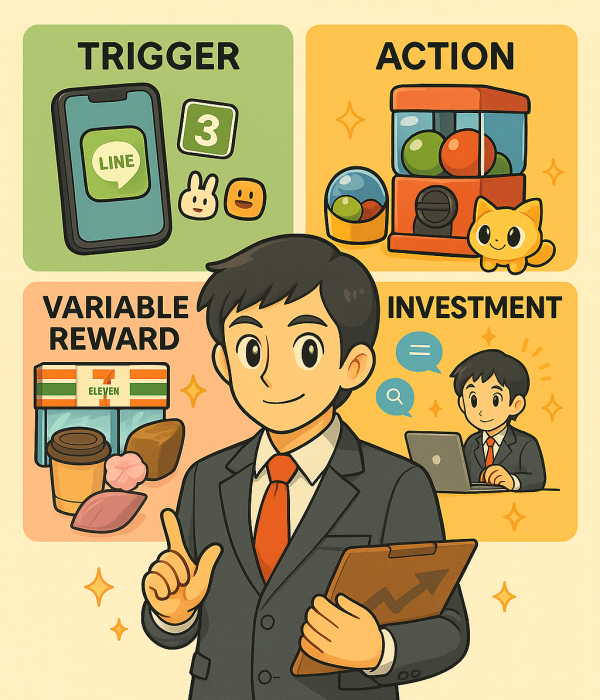
Habitual formation is a powerful to leverage in your marketing strategy. In a world filled with endless daily notifications, capturing attention can be difficult and keeping it even more. Successful brands don’t just advertise, they embed themselves into the everyday lives of there consumers.
Nowhere is this more evident than in Japan, where brands have mastered the art of habit formation. Japanese brands have developed systems that people return to effortlessly and have become essential parts of daily life for consumers. At the core of there strategy is the hook model.
So in this post, we will be looking at what the hook model is, and look at how three brands and industries that have utilized this model to develop habit forming products.
Hook Model
Before we dive into the way Japanese brands leverage habit formation, we need to define what it is and describe how it works. One of the best ways to do this is to look at the Hook Model.
The Hook Model was developed and described by Nir Eyal in his book Hooked: How to Build Habit-Forming Products. The system describes a four-step process in the process of creating habit forming product.
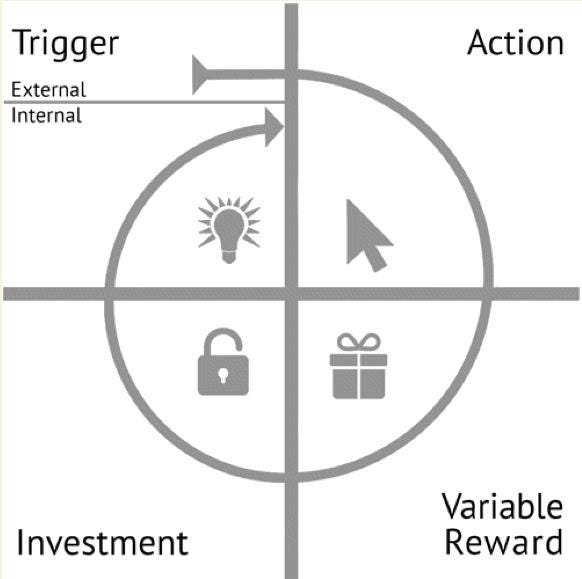
Image Credit: Nir Eyal Hooked: How to Build Habit-Forming Products
- Trigger: Is something that prompts the person to take an action. He lays out two types of triggers, external and internal. An external trigger could be something like a billboard or a notification, while internal triggers are things like thoughts or feelings.
- Action: After the trigger is action. Nir defines this as “the behavior done in anticipation of a reward.” This could be like clicking on an ad and being introduced to that brands landing page. He also highlights that companies can leverage two factors in increasing the likelihood to perform the action. One is the ease of performing an action and the other is psychological motivations to do it.
- Variable Reward: Nir then describes how increasing variability in offerings or adding new content is key. He highlights research that shows that anticipation of reward releases dopamine. Adding variability multiplied that dopamine. Continuing with the previous example, the user has landed on the page and now begins to spend time exploring other products offerings or reading the blog to learn more about the brand.
- Investment: The last phase he highlights is investment, which is the likelihood they pass through the cycle again. It usually requires some sort of investment such as time, money, effort etc. However, what important about the investment is that increases the odds of going through the loop again. Now that the user has gone through the brands site, data on preferences has been collected through cookies has been collected. That can be used to develop future triggers for the user to go through the Hook cycle again.
In Japan it is essential to build relationships and consumer trust. Naturally, many brands have applied this model to there strategy whether they are aware of it or no. From here I will be using this model to breakdown some brands who have leveraged this model effectively.
LINE: The Social Media Ecosystem
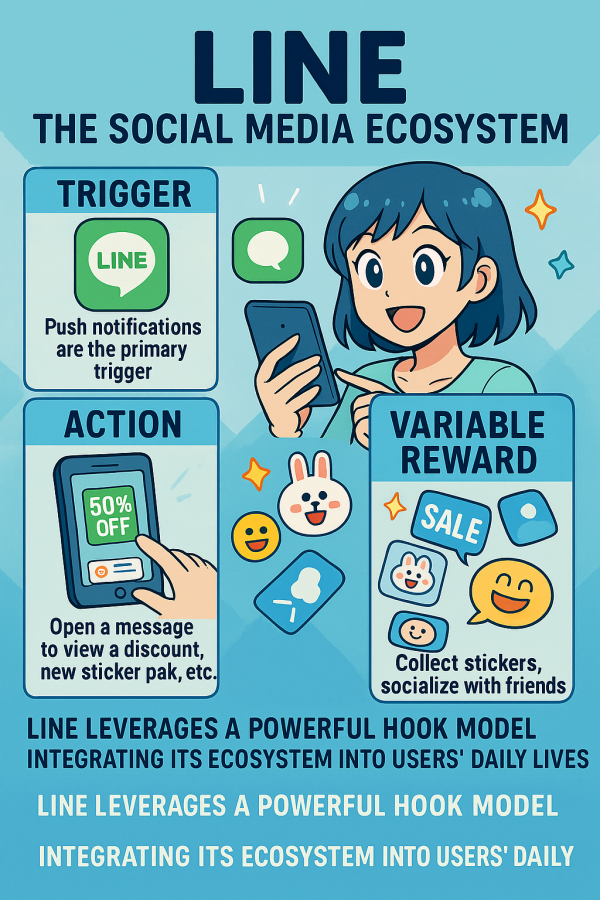
According to Humble Bunny LINE users accounts for 78.1% of the Japanese population with 77.2% of that using it ‘every day.’ That not only makes it the largest but the most used social media platform in Japan.
It has also expanded its ecosystem to incorporate a variety of other apps and features, like games, manga, and news. It also a great way for brands to interact directly with consumers. But part of there success is the way they have mastered the hook model.
- Trigger: In the case of LINE, you are able to directly follow brands and often gain perks for doing. But they also become a source of notifications, promotions, and updates whether its from those brands or from LINE itself which, in my case, notifies me daily of new stickers.
- Action: The action then is opening up that message from LINE or the brand. For certain brands like Mega Big, a karaoke chain, you can make reservation or even check on the points you received besides being able to see the promotion they have sent. In the case of LINE itself click on the promoted sticker will open to the sticker library showing the entirety of the sticker pack.
- Varied Rewards: You can see where this has room for a lot of variable rewards. Taking LINE on its own, they are constantly releasing new stickers from a host of different brands outside of there own stickers or collaborations. If your following other brands than you will constantly receive new updates or the latests deals. Meaning every time you open up your LINE app your exposed to a new discount, sticker, or some sort of new content.
- Investment: The investment then becomes the collection of stickers you can collect and the customization options you have to personalize your LINE. These stickers can be sent through chats to friends and family which can become the source of conversation or to socializing with others, cementing the deep relationship aspect of it.
LINE has cemented itself in the everyday lives of Japanese people and that is for good reason. It has developed a powerful hook cycle that has integrated not only its own products and services, but leverages its platform for other brands to utilize as well. It creates a system that people continuously come back to as we see with many using it everyday.
Gatcha Games: Variable Rewards King
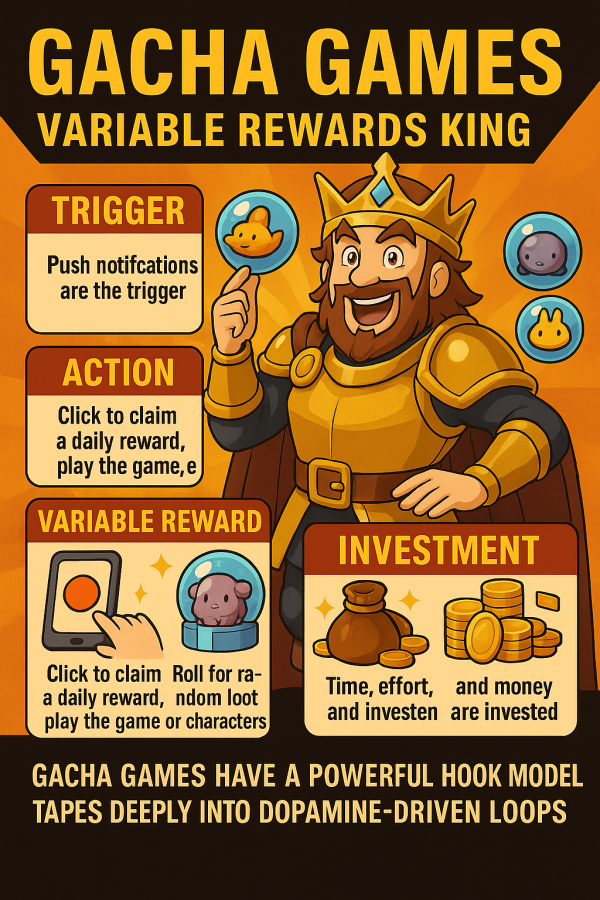
Gatcha games are not a brand but rather a genre or feature for attaining rewards in a game that is completely based on chance. Traditionally, they were machines you put a coin in spin and out came a ball with a random prize from a set of potential prizes, and often has rare prizes.
While these machines still exist, they have been incorporated into digital platforms, specifically, in to mobile games. Why this is important is because according to IMARC the market size reached $USD 7.5 Billion in 2024 and expects the market to reach $19.6 Billion by 2033.
Many of these games incorporate the gatcha elements including top performing games like Monster Strike and Puzzle & Dragons which hook players into the cycle.
- Trigger: Push notifications are the primary trigger that remind you of your daily login bonuses, special events, or special promotions.
- Action: From here you have to click to claim your daily reward which when done can give you a chance to roll for random loot or characters. Similarly you can do thinks like click to play the game to earn currency for more rolls or to clear missions to earn potential roles as rewards.
- Variable Rewards: Here is where gatcha games are powerful. All of the best loot and rare characters can only be earned via this randomize roll. Meaning you have to keep rolling to get new characters and gear. They constantly add new characters and loot which creates a constant desire to get as many rolls opportunities as possible to be able to collect the rare loot.
- Investment: Naturally, you invest a lot of time and effort to grind the game in order to earn the chance to get more rolls. Often time users will even use money to purchase the chance to get rolls or to get rolls with higher chances of earning rare loot. There is also a social investment that maybe is talked about as much as there is a dedicated community of people who exclusively play these games and other mobile games.
Gatcha games have a powerful hook model, that tapes deeply into dopamine-driven loops. It creates strong habitual engagement even for more casual players. Then it is now wonder why the industry is expected to grow by 10% by 2033, and gatcha games are a large chuck of this growth.
Konbini Culture: Daily Routine, Daily Habits
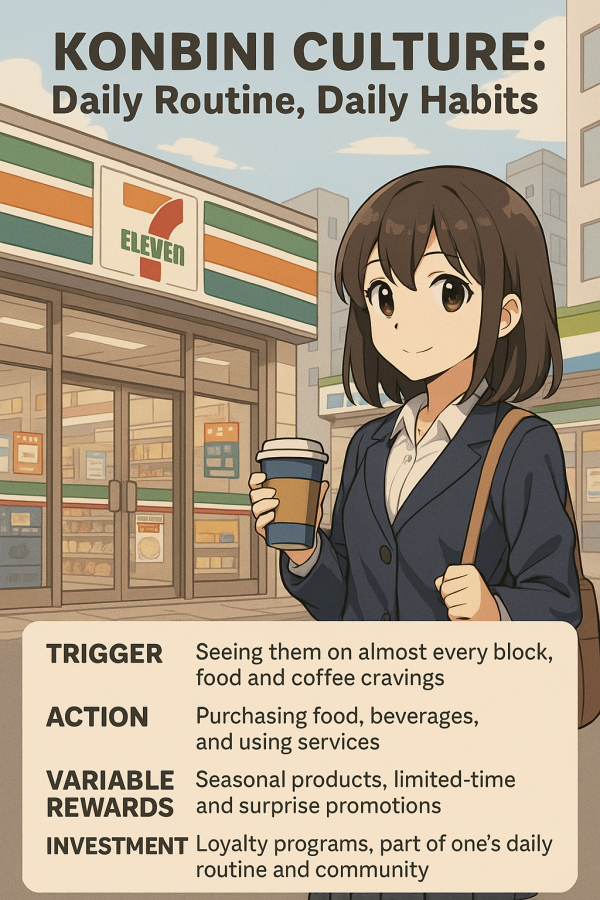
Convenience stores are part of everyday life for Japanese people. They are stores that sell a variety of food, meals, beverages, and daily essentials. They also have a varitey of services like banking, ATMs, ticket pickups, and even the ability to pay bills.
According to Bokksu there are 55,000 convenience stores around Japan. With 90% of the market share owned by the big three 7-Eleven, FamilyMart, and Lawson. Whenever you go to Japan especially in larger cities, you can’t go a block without seeing at least one of these three brands.
- Trigger: The trigger is seeing them in almost every block in Japan, which is a country that requires walking everywhere. Morning coffee cravings, food cravings, and even seasonal campaigns can all be triiggers. In the case of the last one may be confusing but seasonality is baked into Japanese culture and consumer behavior. Meaning the changing of seasons could trigger a craving for something like sweet potato in fall, or Sakura flavored items in spring. One other trigger can also be the chimes of the doors opening, as each has there own distinct recognizable chimes which could be a trigger even if you weren’t the one walking in.
- Action: Would be the purchasing of any of the food or beverages, as well as using the other services like ticket purchasing, paying bills, or using the ATM.
- Variable Rewards: Would be like previously mentioned seasonality is a key aspect of Japanese culture, so naturally there are products that can only be purchased in that season. Similarly, convenience stores will offer limited-time products, collaborate with other brands to release limited products, or have surprise promotions.
- Investment: In terms of investment, many of these convenience stores have loyalty programs, that if you purchase there you get points to earn discounts or free items once you’ve collected enough. A more powerful investment however, is the emotional connection to going to the convenience store and the feeling that is part of ones daily routine. There is also a bit of a social aspect involved, as people have preferences for certain brands of convenience store. This creates a sense of wanting to be a part of that team and community.
Convenience stores have embedded themselves into daily life. With a constant rotation of products, and offering reliable services they have developed a strong emotional familiarity with there consumers. This in turn creates a strong, repeatable habits.
Final Thoughts
Japanese brands excel at developing habit formation among there consumers. Instead of aggressively forcing behavior, they instead embed themselves into daily life, and become an essential aspect of it.
They have mastered the hook model, by creating great triggers, influencing actions, offering a variety of variable rewards, and fostering invested loyalty into the brand. Through the strategic use of this model, brands like LINE, gatcha games, and convenience stores ensure they are not just seen, but used consistently and effortlessly.
For marketers in Japan, or outside of Japan the lesson to take a way is:
Build value naturally, that using your product becomes effortless, and integrates into daily life to form into a habit.
If you like this content, follow me on social media and sign up for my newsletter to get the latest updates.