Don Quijote’s Chaotic Store Strategy: Distribution as Differentiation
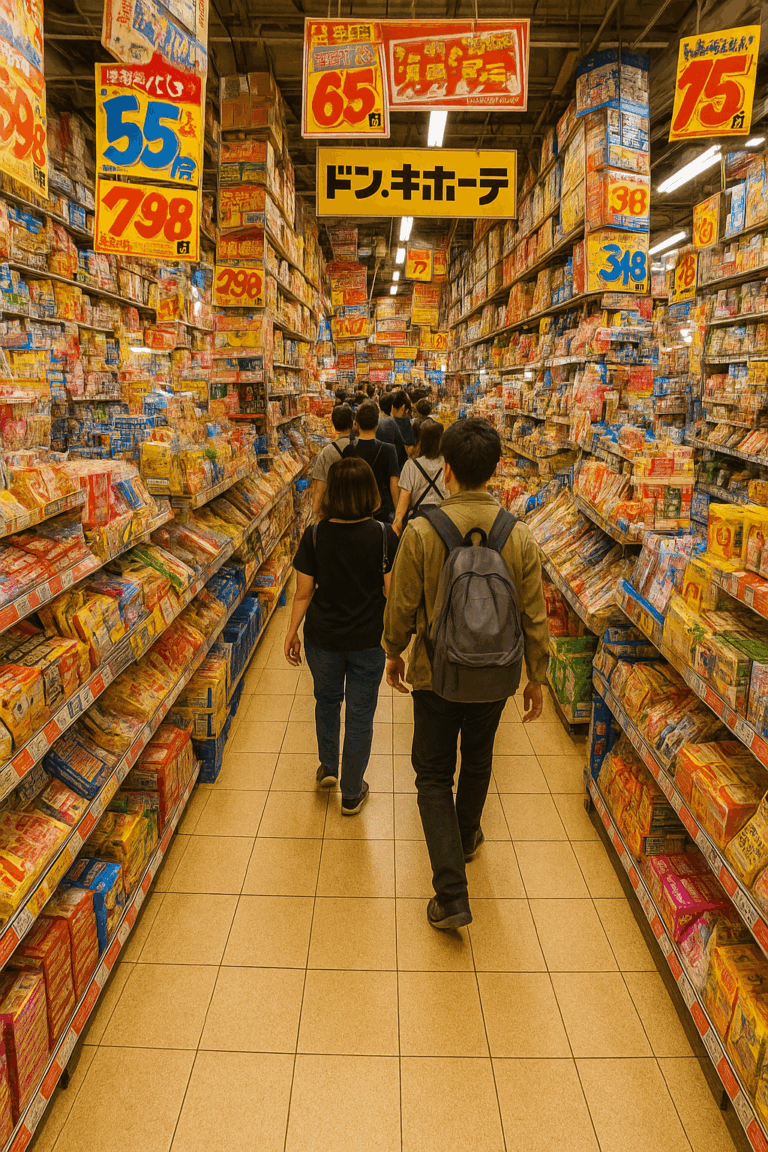
When you first walk into a Don Quijote (ドン・キホーテ), also known as Donki (ドンキ), it feels like stepping into a hell realm of pure nightmarish retail chaos. The aisles are so narrow you have to shuffle between them as crowds of people block the paths. Around you, merchandise is stacked in towers touching the ceiling. At the same time, handwritten signs scream prices and sales in neon colors. All the while, an incomprehensible mix of products, ranging from groceries and luxury goods to cosmetics, sex toys, electronics, and souvenirs, is crammed onto the shelves, barely intelligible and without any sense of where you actually are in the store.
To the normal person, it looks like sloppy organization. To branding experts, however, it is something else completely: distribution as differentiation. Donki’s chaos is actually a carefully designed strategy that creates unforgettable customer experiences and builds powerful brand equity in Japan and around the world. So let’s break down this strategy of chaos.
Distribution as Differentiation
According to Investopedia, a distribution channel represents a chain of businesses or intermediaries through which the final buyer purchases a good or service. For those who are familiar with the four Ps of marketing, distribution in this case is equivalent to place.
This means it is an important channel that can directly influence brand equity. For Donki, stores aren’t just places to move products, but are touchpoints that define the brand image itself.
Unlike most Japanese retailers that have neat layouts and are well organized, Donki doubles down on two principles: convenience and access. We can see in its distribution strategy.
First, is that it often has 24/7 opening hours. This makes it the go-to destination for late-night shoppers, night-shift workers, and even jet-lagged tourists.
This ties to the second, which is prime location choices. These stores are often located in high-traffic locations like Shinjuku and Akihabara in Tokyo, or Dotonbori in Osaka. These also happen to be major tourist locations, which turn the store into an attraction itself. For locals, they are often conveniently located.
Finally, they were able to successfully export this model into foreign markets, particularly Singapore, Hong Kong, and Thailand.
The “Treasure Hunt” Experience
At the heart of Donik’s strategy and chaos is what the Japan Times calls the“treasure hunt” experience. They further highlight how inbound tourists will often crowd the aisles in search of quirky Japanese souvenirs and snacks.
The underlying tactic that drives this is Donki’s own proprietary merchandising method, which they call compression display. This is purposely stacking products on the shelf to the point that they form towers up to the ceiling. It also maximizes storage as all the products are generally out on the floor.
This tactic, however, transforms shopping from a chore into a form of experiential marketing that focuses on ‘wow’ experiences that drive brand equity. Customers will wander through the aisles, never quite knowing what they may stumble upon. From cheap sushi to luxury goods, this exploration of chaos and making a new discovery rewards shoppers with small dopamine hits every time they find a deal.
This unpredictability transforms shopping into a form of entertainment. This is important as it directly compensates for the rise of e-commerce. Instead of competing with Amazon or Rakuten on efficiency, Donki offers something they can’t: the thrill of an in-person discovery.
Localization and Customerization
Another really important aspect of Donki’s strategy is its careful attention to localization. This is a key strategy for any brand wishing to succeed in Japan and is another great example of this.
As we mentioned, part of their distribution strategy is to be in prime high-traffic, tourist-heavy districts. In these areas, what you will find is shelves brimming with Japanese souvenirs, KitKat varieties, cosmetics, and electronics.
However, when we go outside to a more suburban area where locals are, the product mix shifts to more groceries, daily necessities, and home goods. It also changes in international stores, where it’ll adapt to local needs but will retain its Japanese flair by stocking anime merchandise and snacks.
This shows that Donki isn’t just throwing its chaotic model anywhere and everywhere, but fine-tunes that model to fit the local needs. This is also known as personalization, where brands identify and meet the unique needs of their customers.
Organized Chaos as Brand Equity
Donki’s success ultimately shows that distribution is not just logistics or placement of stores, it’s branding. Every choice from the location to the neon-colored price tags to the eccentric penguin mascot, Donpen, reinforces a brand identity that is eccentric, playful, and unpredictable.
By keeping stores open 24/7, packing aisles with a chaotic mix of goods, tailoring product mixes to each location, and leaning into its eccentric personality, Donki has built a brand that is unforgettable, differentiated, and profitable.
Nippon.com explains, Donki has become a retail “national phenomenon” because it embraces chaos as a strategy. For marketers, the lesson is that distribution and channel design can be powerful levers of brand equity, and even the chaos, if strategically executed, can become a competitive advantage.