Why Japanese Beer Drinkers Stay Loyal to Asahi and Kirin
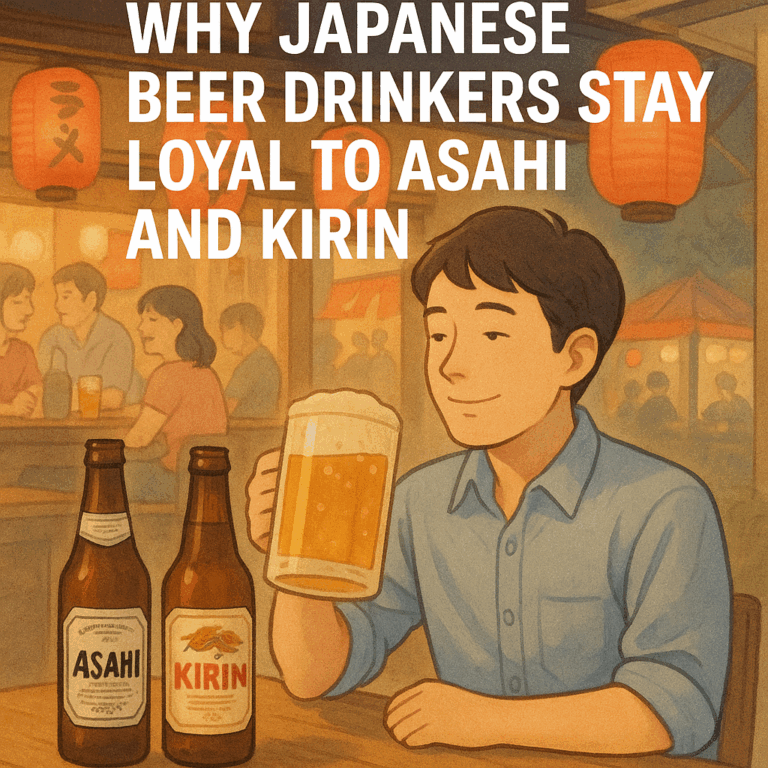
Beer in Japan is more than just a drink, it has become a cultural staple. In Japan, it has become the default beverage of choice. From nomikai (Japanese drinking parties typically done after work), to meals at home, and even the go to matsuri (Japanese festivals), this drink is everywhere.
It would be reasonable to assume that the markets would be competitive in such a developed market. However, two brands continue to dominate: Asahi and Kirin.
Their constant presence in Japanese life is not just about taste. It’s a mix of perception, cultural rituals, distribution, brand evolution, and adapting to consumer preference changes.
We will dive into what makes these two giants in the beer industry a constant presence in Japanese life and how you can learn to use the same techniques in your marketing strategy.
Clear Taste Signatures That Shape Perceptions
Asahi Super Dry
One of the strongest reasons for loyalty is how each brand positions its tastes. In 1987, Asahi launched its most famous beer, Asahi Super Dry. At the time, beers were far different, with richer and maltier beers being dominant in the market. However, Asahi decided to create a karakuchi (辛口) style beer, which was a crisp, dry lager with a cleaner finish and did not linger on the palate. Its sharp, refreshing profile started to become synonymous with modernity and food friendliness. Particularly in Japan’s dining culture, where beer is consumed alongside a wide variety of dishes, as is typically seen in izakaya.
Kirin Ichiban
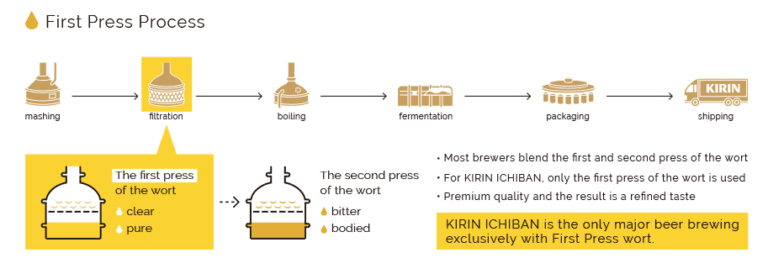
Kirin took a different path. Kirin launched its original lager back in 1888, which is still one of its best-selling beers. However, in 1990, they launched their flagship beer, Kirin Ichiban. Most brewers use wort from the first and second filtrations of beer making. Kirin Ichiban, however, is the only mass-market beer brewed only from the wort from the first filtration, hence the term Ichiban (一番), which means first. Despite being a 100% malt beer, this process allows it to create a more delicate beer that is light and aromatic. This is similar to what we saw with Asahi, making it a perfect option to pair with a wide variety of Japanese food, which it is typically paired with. However, it is different in the narrative and story that it creates as a cognitive anchor. This beer may taste similar or have a similar profile to Asahi, but it makes up for it with a strong story about its process, which gives the consumer a feel that this is a premium beer.
By maintaining clear and distinct sensory “signatures,” both Asahi and Kirin have shaped how drinkers perceive them. This clarity reduces uncertainty and ensures consumers know exactly what they’re getting when they choose either brand.
Loyalty Reinforced Through Habit and Ritual
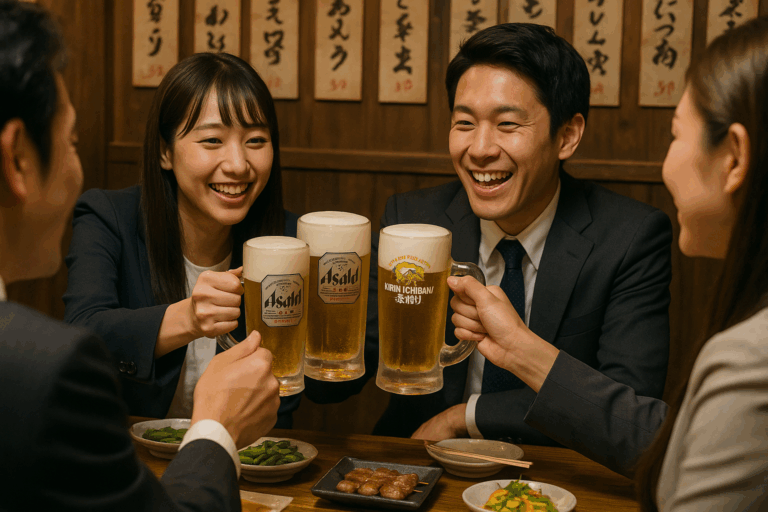
Japanese drinking culture also plays a critical role in cementing loyalty. Beer is often the first drink at social outings such as a nomikai. These are best described as a drinking party or gathering, typically with your coworkers. They can be a company or office-wide gathering or with a few of your coworkers. The idea behind this practice is for teams to bond and provide a space for them to loosen up and create a more consiliatory atmosphere. However, in these moments, as in others, choosing a mainstream, trusted brand minimizes risk. Ordering Asahi or Kirin also signals group belonging, making these brands safe and socially approved options.
Distribution also reinforces a lot of these habits. A location that is found at almost every corner in Japan, and is a staple in Japanese daily life, is the convenience store (konbini). Walk into any of the variety of brands of convenience stores and you’ll find Asahi and Kirin. Walk into any supermarket and you’ll find boxes and cans of Asahi and Kirin. Go to an izakaya? You’ll only have one choice usually, but it’ll be either Asahi or Kirin. These two brands are ingrained in all major distribution points for people’s daily lives.
Even at the most traditional of Japanese cultural events, matsuri, you will find beer being the beverage of choice. Most people would think they would be downing shots of sake, which they are probably also doing, but you will be surprised how much beer you will see as well. As the yatai or Japanese floats are being dragged about, you’ll often see beers of Asahi and Kirin being passed along the line. Even the local vendors who sell beer will probably be handing out one of these two. This beer culture at these events became such a thing that even a local brand called Hino Brewing branded itself as a matsuri beer for its local town, something that it has tried to spread to other matsuri as well.
Always evolving, Never Rebranding
Another key takeaway and interesting aspect of these two brands is that they are always evolving. They rely on brand evolution rather than rebranding when things start to slow down. This is not as easy as it sounds, as it requires very subtle and incremental changes that refresh perceptions without alienating existing fans, a difficult effort especially in Japan.
A great example of this is Asahi. According to Asahi’s own data, a recent “full renewal” of Super Dry, which included a subtle tweak to taste and packaging, actually increased post-drinking satisfaction scores from about 82% to over 92%.
For Kirin, it has been a little more subtle than changing its recipe. Rather, it keeps its Iciban untouched while still focusing on its core story of the “first press” brewing method. However, it does frequently update its branding that refreshes its image, but not so drastically as to deter loyalists. It also experiments with seasonal and limited-edition flavors, such as flavors for Japanese seasons.
This strategy contrasts with rebranding, which risks breaking emotional and familiar bonds. Japanese consumers value stability and consistency in everyday products, especially in categories like beer, where loyalty is often tied to habit. By maintaining core brand identities while layering on novelty, Asahi and Kirin avoid the pitfalls of dissonance while remaining relevant.
Adapting to Health Trends and Market Pressures
While tradition remains central to beer culture in Japan, long-term loyalty will start to depend on how brands adapt to shifting consumer preferences and regulatory obstacles. Kirin highlights many of the challenges facing the current market in their Investor Guide. One thing they highlight is the overall decline of beer consumption. This is believed to be due to an aging population, increasing health consciousness, and the increasing popularity of cocktails and ready-to-drink beverages. Furthermore, tax reforms are changing the landscape by narrowing price gaps between regular beer and low-malt beers like happoshu, which aren’t classified as beers and were previously taxed differently.
This, however, isn’t being viewed as an obstacle, and rather, it has been highlighted as an opportunity for both Asahi and Kirin. As the Food Navigator Asia details, Kirin has begun to place its low and non-alcoholic beverages at the center of its 2025 strategy, aligning with government encouragement of responsible drinking and consumer interest in health. Asahi has developed its Asahi Super Dry Dry Crystalm, which is a lower alcohol level beer with reduced calories and carbohydrates. This is aimed at younger drinkers, who are moderating their intake, and Asahi could represent a substantial portion of future sales.
It is also important to know that Japanese consumers tend to fall back on trusted brands. By expanding their product portfolios without changing core identities, Asahi and Kirin ensure that loyalty endures even as the market itself evolves. Further highlighting the importance of trust and developing loyalty in your brand to withstand changing times.
Key Takeaways for Marketers
The story of Asahi and Kirin’s enduring loyalty offers valuable lessons for marketers in any industry:
- Anchor loyalty in perception: Distinctive sensory or narrative cues create mental shortcuts that consumers trust.
- Reinforce loyalty through cultural rituals: Embed your brand in everyday routines and social occasions so choosing it becomes a safe, habitual decision.
- Evolve, don’t rebrand: Small product or packaging changes, refresh and maintain relevance without breaking the emotional bond that fuels long-term loyalty.
- Respond to shifting trends proactively: Anticipate consumer lifestyle changes, particularly in categories that are considered “unhealthy.”
- Trust breeds resilience: Building trust today maintains loyalty into the future, even during changing or hard times.